Exploring Hearing Aids, Assistive Devices, and More
When a child is first diagnosed with hearing loss, it can feel overwhelming. Yet the truth is, there are more options than ever before to help children access sound, language, and connection. At Show Hope, we believe every child deserves to be seen and heard, known and empowered. Advances in hearing and assistive technology have opened doors for children with hearing loss in amazing ways. Below you’ll find common hearing aids and hearing assistive devices available for children—including newer tablet-based and smart devices—along with how they support development, communication, and confidence.
Hearing Aids
Hearing aids are often the first line of support for children with mild to severe hearing loss. These devices amplify sound and are carefully programmed to match a child’s specific hearing needs.
Behind-the-ear (BTE) hearing aids are the most common style for children. The device(s) rests behind the ear and connects to a custom earmold that fits just inside the ear. These are often recommended for children, including infants and toddlers, because they are …
- Safe, adaptable, and powerful enough across a range of hearing levels
- Durable and built to withstand active lifestyles
- Compatible with many assistive listening devices
- Easy to adjust as a child grows
- Available in fun colors that help children feel more confident
Receiver-in-Canal (RIC) Hearing Aids
Receiver-in-Canal (RIC) hearing aids are similar to BTEs but are smaller. The speaker (or receiver) sits inside the ear canal rather than in the main body of the device. This type of hearing aid may be more appropriate for older children or teens with mild to moderate hearing loss, especially those who desire a more discreet option. Not all younger children are candidates, as durability and growth considerations still matter.
Bone Conduction Hearing Devices
For children who have certain types of hearing loss, such as conductive hearing loss or anatomical differences, bone conduction devices can be transformative.
With softband bone conduction devices, these sit on a soft headband and transmit sound vibrations through bone directly to the inner ear, bypassing the outer and middle ear. These devices are commonly used for babies and toddlers, children with microtia or atresia, or for children with temporary conductive hearing loss. Softbands allow very young children access to sound during critical language-development years.
For older children, a surgically implanted bone-anchored system may be recommended. These attach to a small implant in the skull and transmit sound through bone conduction. The decision to pursue implantation is personal and made in close consultation with your doctor. For many families, it can provide improved sound clarity and consistent access to hearing.
Cochlear Implants
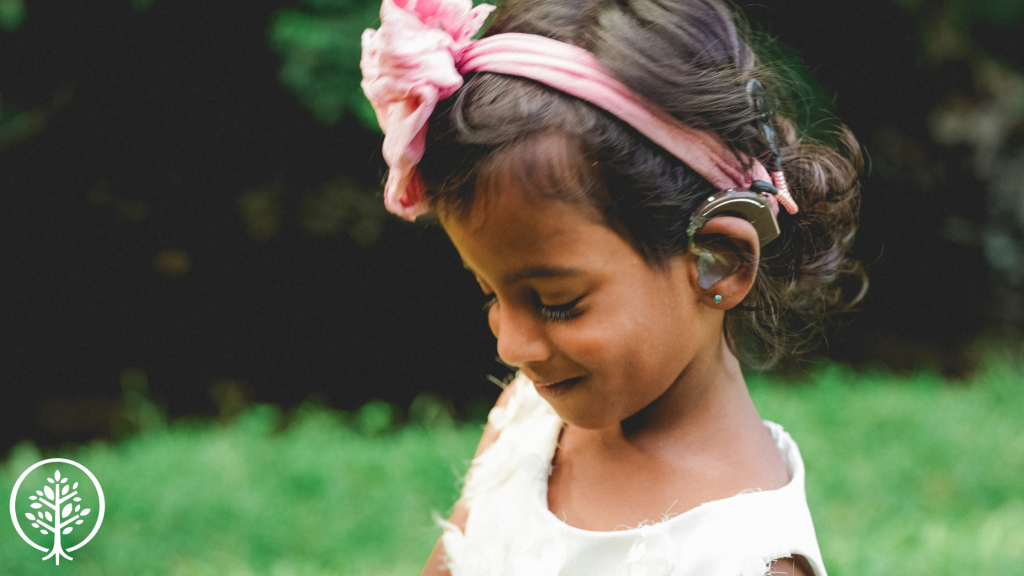
For children with severe to profound sensorineural hearing loss who receive limited benefit from traditional hearing aids, cochlear implants may be an option. Unlike hearing aids, which amplify sound, cochlear implants bypass damaged portions of the inner ear and directly stimulate the auditory nerve. These implants include both internal (surgically implanted) and external components. Cochlear implants do require the following:
- Comprehensive evaluations
- Surgery
- Ongoing therapy and mapping appointments
- Family commitment to language-development support
For many children and teens, cochlear implants open the door to spoken language access. For others, they are part of a broader communication approach that may include sign language. As with most medical needs, each family’s journey is unique.
Tablet-Based and Smart Listening Devices
Particularly in educational and therapy settings, technology has emerged that expands the ways children can access and interact with sound. These tablet-like or smart assistive devices function like dedicated listening stations that pair with apps, remote microphones, or classroom systems and often include features that support learning and language development.
Many of these devices allow children to adjust volume, frequency emphasis, or listening modes in real time, giving them greater awareness and control over their listening environment. Integrated software apps also support auditory training, speech therapy exercises, and audio/visual learning tools, turning listening practice into an engaging experience. Together with a microphone, tablet-based devices can stream the speaker’s voice directly to the child’s device, improving access in noisy settings. And because these devices look and feel like common tablets, many children, particularly school-aged kids and teens—find these devices intuitive and confidence-boosting.
It is important to note: These tools are not a replacement for hearing aids or cochlear implants when those are appropriate. Instead, these devices serve as complementary technology that can enhance sound access, practice, and participation.
Hearing Assistive Technology (HAT)
Even with hearing aids, implants, or smart devices, children may benefit from additional technology to improve listening in challenging environments. For instance, FM and remote microphone systems use a microphone worn by a teacher or caregiver to transmit sound directly to a child’s hearing device. This helps reduce background noise, improve speech clarity, and support classroom learning. For school-aged children or teens, remote microphone systems can significantly improve academic access and confidence. Additional HAT includes captioned telephones, visual alert systems, bluetooth streaming accessories, and soundfield systems in classrooms. These types of devices work together to create a more accessible daily environment.
Just like every family’s journey is different, every child’s hearing profile is different. What matters most is early identification, consistent support, and a team that walks with you through the process. When children have access to appropriate devices, technology, and intentional language input—whether spoken, signed, or both—they will be positioned to thrive at home, in the classroom, and within their community.
At Show Hope, we have had the privilege of walking with families who are navigating hearing loss in their children and teens welcomed home through adoption. Our Medical Care grants have helped provide financial support for different devices and technology, and we would be honored to walk with your family on the adoption journey too. You can learn more about Show Hope Medical Care grants by visiting showhope.org/medicalcare.